
- How to Differentiate Fixed and Variable Costs
- Fixed costs
Fixed costs and variable costs: How to distinguish between them to ensure the proper management of your business?
How we verified this
We cross-referenced public data (BLS, SBA, Federal Reserve, major industry reports) against our own review of this topic. Where specific numbers appear, we link the primary source. Where sources disagree, we note the discrepancy rather than pick a single figure.
Key Takeaways
- Fixed costs (rent, salaries, insurance) remain the same whether you produce one unit or ten thousand units.
- Variable costs (raw materials, shipping, sales commissions) rise and fall in direct proportion to production volume.
- Knowing your cost structure helps you set prices, calculate break-even points, and make profitable scaling decisions.
How to Differentiate Fixed and Variable Costs
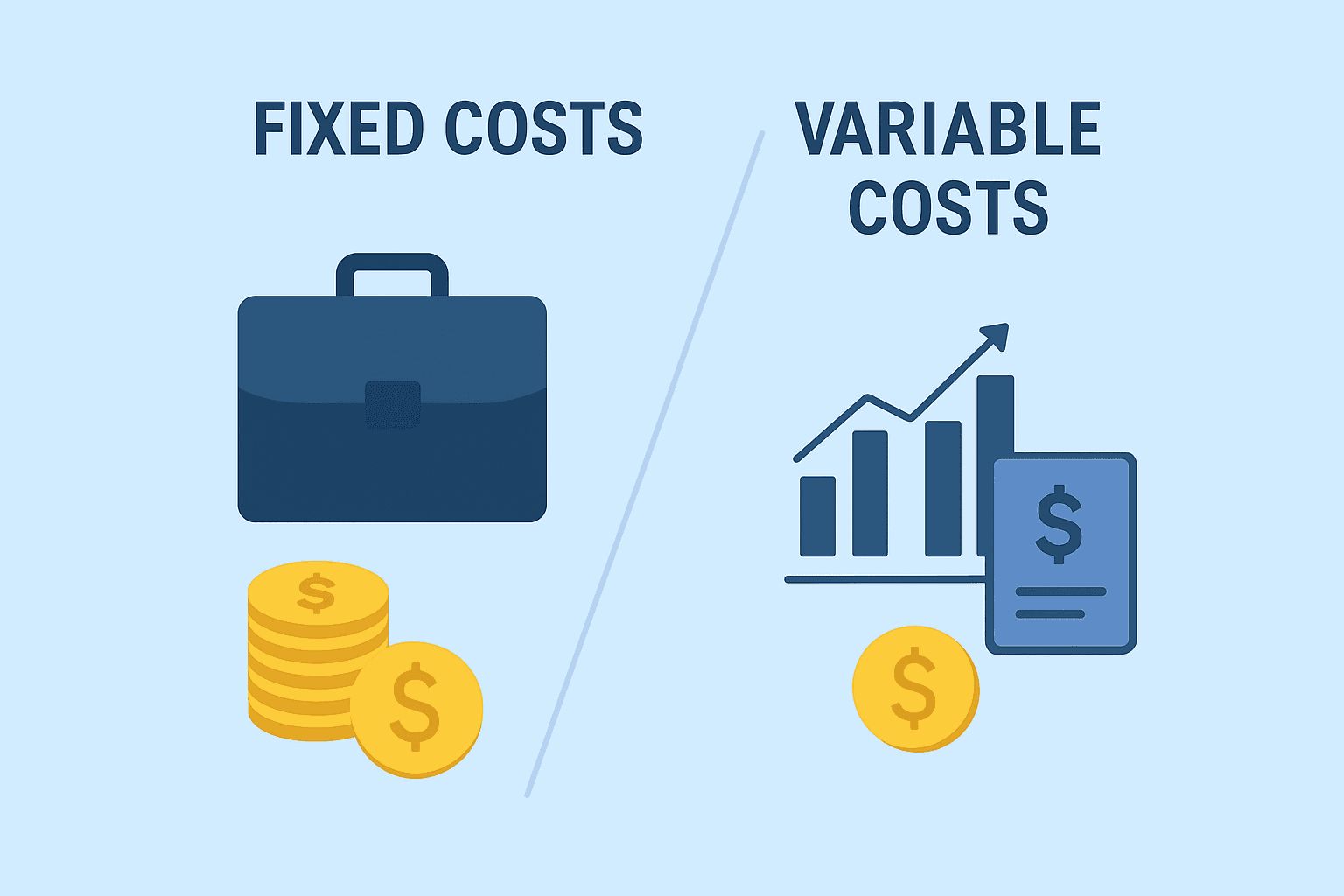
In business management, understanding fixed and variable costs is essential. These cost types have different characteristics. Fixed costs do not change with production levels.
Variable costs fluctuate with output. Knowing the difference helps in decision-making.
As a leader or manager, you need to understand both categories of expenses to make informed and strategic decisions about your finances. By understanding these fundamental concepts, you will be better equipped to optimize your financial strategies and ensure the sustainable growth of your business.
Fixed costs
Definition and characteristics of fixed costs
Fixed costs (or fixed expenses) represent a key component of a company’s expenses, characterized by their immutability regardless of the company’s economic activity. Unlike variable costs, Fixed costs do not change with the company’s production or sales volume. Common examples include rent, salaries of administrative staff, insurance costs, and expenses from equipment and facilities depreciation.
The static nature of fixed costs makes them an integral part of a company’s cost structure. Regardless of a company’s business performance, these costs must be incurred. This means that even in the event of a temporary decline in activity, the company continues to bear these costs, which can significantly impact its profitability and financial stability.
Effect of Fixed Costs on Company Profits and Stability
Fixed costs play an important role assessing a company’s profitability. These expenses need coverage before any profit is made. Therefore, when a company’s revenue is insufficient to cover its fixed costs, it may find itself in financial difficulty, even if it generates significant revenue.
This situation can compromise its ability to invest in new projects or expand.
Furthermore, although fixed costs can create financial stability by ensuring a constant expenditure base, they can also pose a risk in the event of unforeseen fluctuations in economic activity. For example, a sudden drop in demand for the company’s products or services can lead to underutilization of resources and therefore economic inefficiency.
Although fixed costs are necessary for the operation of the business and can provide some predictability, they require careful management to prevent them from compromising the profitability and financial stability of the business, especially during times of economic volatility.
Variable costs
Definition and characteristics of variable costs
Unlike fixed costs, variable costs change with the company’s level of activity. These expenses change based on production or sales levels. Examples include the cost of raw materials, sales commissions, transportation costs, and production subcontracting costs.
Variable costs change with the company’s activity level. As production or sales rise, these costs also rise, and they decrease when production or sales fall. This flexibility helps companies adjust expenses based on market demand.
It allows for a more adaptable cost structure in response to economic changes.
Importance of controlling variable costs for profit optimization
Managing variable costs effectively is crucial for maximizing a company’s profits. Companies can minimize costs per unit by monitoring and controlling these expenses. This allows them to adjust their production or sales levels and improve their profit margin.
For example, by negotiating better rates with raw material suppliers or optimizing production processes, a company can reduce its variable costs and increase its profits.
Additionally, proactive variable cost management enables businesses to better respond to market changes and remain competitive. By identifying cost optimization opportunities and implementing effective strategies, companies can improve their operational agility and ability to quickly adapt to changing demand.
Examples of fixed and variable costs
Fixed costs include, for example:
- Rent
- Salaries and wages
- Operating costs for office space (electricity, heating, water)
- Insurance
- Software license fees
- Flat-rate repair fees for machines
- Leasing fees for vehicles or machinery
Variable costs include:
- Costs for raw materials, intermediate products or goods (these vary depending on how much is produced)
- Transport and shipping costs (the more items are sold, the higher the costs are)
- Energy costs for production facilities (the longer the machines run, the more energy they consume)
Distinguish between fixed and variable costs
It’s not always easy to distinguish between fixed and variable costs in cost accounting. For example, salaries are usually fixed or constant over a longer period of time, which is why they are classified as fixed costs.
However, for a manufacturing company that pays piecework wages (i.e. based on performance), these wage payments are variable costs — after all, they are not constant and fluctuate depending on the order situation.
Sometimes cost items consist of a variable and a fixed cost component, for example, energy costs for operating machines. A flat-rate electricity charge is charged in the form of the base price, which represents a fixed cost. Variable costs arise depending on consumption.
If the machine runs around the clock, the variable costs are higher than if it is idle. However, the flat-rate electricity charge always remains the same.
Special case: Step-fixed costs
Sometimes it happens that fixed costs become variable costs—in this case, step-fixed costs occur. This occurs, for example, when production volume increases so much that the company needs to provide an additional machine to process the orders.
The purchase of the new machine then leads to a sharp increase in fixed costs, hence the name “step fixed costs.” After this increase, they then remain constant again.
How do you calculate fixed and variable costs?
There are different ways to calculate fixed and variable costs – depending on what you are interested in or what quantities you have available for calculation.
Formula for fixed and variable costs with total costs
The combination of fixed and variable costs results in a company’s overall expenses. This relationship can be expressed as a formula:
Total Costs = Fixed Costs + Variable Costs
To calculate the total costs, you need to identify and sum up all fixed and variable costs.
For instance, if you already know the total costs and the fixed costs, you can adjust the formula to determine the variable costs:
Variable Costs = Total Costs – Fixed Costs
Cost function for variable and fixed costs
To calculate total costs in detail, a cost function for fixed and variable costs is necessary. This expands the formula to include the quantity of goods produced.
Total costs = fixed costs + variable costs * quantity produced
Fixed and variable costs determine the price calculation
Pricing decisions heavily rely on understanding fixed and variable costs. You need to know both types of costs to cover expenses and earn a profit. This knowledge is essential for setting appropriate prices for a product or service.
Calculate contribution margin
The first step in pricing is to create an overview of all fixed and variable costs associated with manufacturing a product or designing a service.
The following applies to fixed costs: These must be as low as possible, as they always arise, regardless of whether you sell just one product or hundreds per year. An essential metric for this is the contribution margin. It shows the amount required to cover fixed costs.
Contribution margin = sales – variable costs
Variable costs vary based on the output volume. As the output volume increases, the variable costs also increase.
Variable costs = output quantity * variable unit costs
For sales, use the following formula:
Sales = unit price x sales volume
The output and sales volume are not the same. Output is the number of products produced. Sales volume is the number of products actually sold.
Determine the amount of fixed costs from the contribution margin
Setting a specific price for a product or service and determining the quantity sold in a given period allows you to calculate the contribution margin. You then compare this margin with the fixed costs. If they are equal, you’ve reached the break-even point, where production covers all costs.
At the break-even point, you generate neither profit nor loss—you only make a profit when it exceeds your fixed costs. Price calculations often require a bit of experimentation, especially if you don’t yet have any experience with output and sales
Conclusion on fixed and variable charges
Understanding the concepts of fixed and variable costs is essential for any business wishing to thrive in a competitive economic environment. As a manager or executive, your ability to balance these two types of expenses will directly impact your company’s profitability and financial stability. By applying sound fixed and variable cost management, you can maximize your profits, strengthen your competitiveness, and ensure the long-term viability of your business.
Why do we differentiate between fixed and variable costs?
The difference between fixed and variable costs lies in their occurrence. Fixed costs arise regardless of the quantity of output produced, whereas variable costs are linked to the production and sales volume. The more that is produced, the higher the variable costs generally are.
Are depreciation costs variable or fixed?
Depreciation is typically a fixed cost. It is calculated for the loss in value of fixed assets such as machinery, vehicles, or buildings and is therefore independent of production volume. The value decreases over a set period of time.
This occurs regardless of how much the asset is used.
Are manufacturing wages fixed or variable costs?
Manufacturing wages can be fixed or variable costs, depending on the type of compensation. A fixed monthly salary is a fixed cost. However, if wages are based on the number of units or production volume (as with piecework), they are variable costs.
Related Articles:
- Fixed assets vs. current assets: what are the differences?
- Expense Account in Business: A Beginner’s Guide
When this guide isn't for you
This is written for owner-operators and small teams doing their own books or working with a bookkeeper. If you run a regulated industry with complex consolidation (multi-entity real estate, SaaS with deferred revenue at scale, medical billing with specific payer rules), you probably need a specialist accountant and an ERP rather than a general small-business approach.
Frequently Asked Questions
Why is it important to distinguish between fixed and variable costs?
Distinguishing between fixed and variable costs helps businesses calculate their break-even point, set appropriate pricing, and forecast profitability at different sales volumes. It also allows managers to identify which costs can be reduced when revenue declines.
Can a cost be both fixed and variable?
Some costs are considered semi-variable or mixed costs because they have both a fixed and a variable component. For example, a utility bill may include a fixed base charge plus a variable charge that depends on usage levels.
How do fixed and variable costs affect pricing decisions?
Businesses need to cover all fixed costs regardless of output, so pricing must account for both fixed overhead and per-unit variable costs. Understanding this breakdown helps set prices that ensure profitability while remaining competitive in the market.