
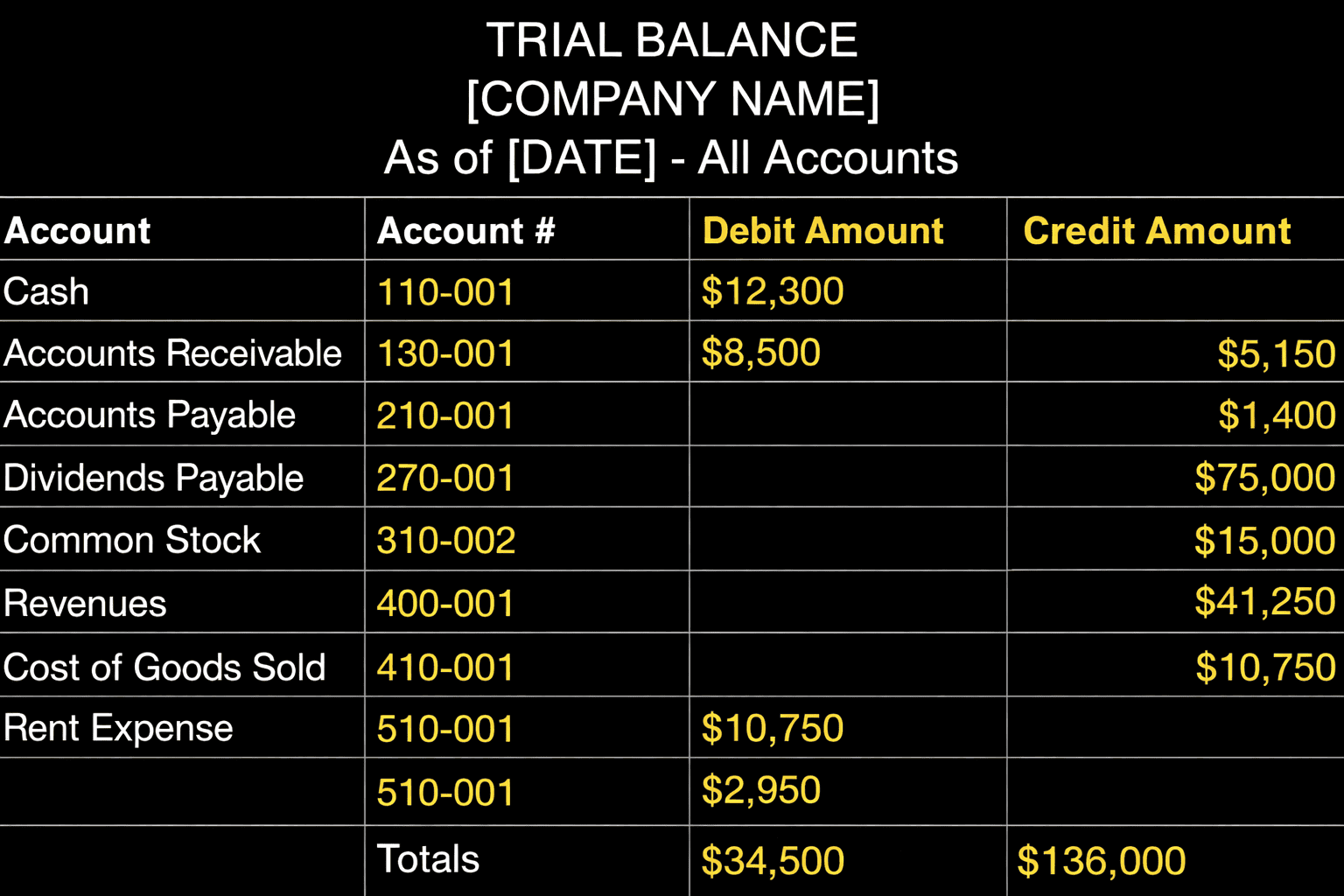
- What is the trial balance in accounting?
- Why is Trial Balance important?
This guide covers what is a trial balance everything you need to know in practical detail, including what it means, how it works, and when to use it.
How we verified this
We cross-referenced public data (BLS, SBA, Federal Reserve, major industry reports) against our own review of this topic. Where specific numbers appear, we link the primary source. Where sources disagree, we note the discrepancy rather than pick a single figure.
If you manage your company’s accounting, it’s essential that you understand the concept of a trial balance and its usefulness. What exactly does a trial balance do? How does it work in practice?
Key Takeaways
- A trial balance is an accounting report that lists every account and its balance to confirm total debits equal total credits before preparing financial statements.
- The three types are unadjusted (before corrections), adjusted (after period-end entries), and post-closing (after revenue and expense accounts are zeroed out).
- If debits and credits do not match, it signals a posting error in the journal or ledger that must be corrected before proceeding.
The trial balance plays a fundamental role as the first step in an internal control process. Its purpose is to ensure companies keep their accounts up to date and that any errors are detected and corrected.
What is the trial balance in accounting?
A Trial Balance is a statement that displays the balance of various accounts. It is an accounting report used to check the accuracy of all accounting entries at the end of the accounting period. It is prepared according to the accounting cycle, which may be specified as a 1-month, 3-month, 6-month, or 1-year cycle, depending on the business’s determination.
Or taking various figures recorded in the accounting cycle of the company’s internal operations to check the accuracy of the accounting records. Before the figures are released as a trial balance, they must be recorded in various journals, such as purchase journals, sales journals, payment journals, receipt journals, and general journals.
Why is Trial Balance important?
As you know, accounting /bookkeeping is all about balance. The accounting equation needs to balance, every transaction needs to balance, our debits and credits need to balance and so on.
The trial balance is our business accounting equation spelled out in detail. Assets, expenses, and withdrawals are on the left or debit side of the trial balance. Liabilities, revenues, and owner’s equity are on the right or credit side.
We can see everything clearly and make sure it balances.
A balanced trial balance tells us that we have done everything we could in the journals and ledgers correctly. It says, “All your transactions for the year have been entered, and everything looks correct!”
As you might have guessed, in the real world, trial balances don’t always balance the first time around. Like anything, human error will occur, and someone has likely entered a bad journal entry or processed the ledger incorrectly. Therefore, at the trial balance stage, accountants and bookkeepers are often forced to review vouchers, journals, and ledgers to find errors and restore account balances.
This shows the importance of creating a trial balance – it tells users that the accounting equation is out of balance and needs to be corrected before proceeding further.
Creating a trial balance is the final step of data processing – after that, we can start creating our financial statements!
Types of Trial Balance
The trial balance format is divided into three types, namely before adjustment, after adjustment, and closing.
An explanation of each type of trial balance is as follows:
1. Tri Balance Before Adjustment
After all transactions are recorded in the general ledger, an unadjusted trial balance is prepared. The notes from the ledger accounts are then transferred to this trial balance. Creating this type of trial balance helps identify any posting errors in the ledger.
2. Tri Balance After Adjustment
An adjusted trial balance, or trial balance after adjustments, is created once specific accounts are modified.
This adjustment needs to be made so that the financial report can describe the actual condition of the organization or company.
3. Closing Trial Balance
A post-closing trial balance is prepared to verify that the general ledger is balanced for the next period.
What needs to be ensured is that all accounts and their values in the balance sheet and the end-of-period balance sheet must be the same.
Trial Balance Function
The balance sheet has several functions. These functions are explained as follows:
1. Recording Function
The trial balance serves to record all account data. This function is very important and needed, especially in the field of accounting.
2. Correction Function
The trial balance serves to correct recording errors. For example, there is a lack of balance records or excess.
3. Monitoring Function
The trial balance is also used for monitoring function. It helps ensure that financial reports are more controlled.
4. Preparation Function
It also helps in preparing financial reports at the end of a period. It also serves as a reference for business planning in the next period.
Benefits of Preparing a Trial Balance
The trial balance has important benefits that can be felt by an organization or business. Therefore, this bookkeeping report cannot be missed in the accounting cycle.
There are several benefits to preparing a trial balance, including:
1. For Financial Reports
The trial balance is often likened to a link between accounting records and financial statements. The trial balance can make it easier for you if you want to prepare financial statements.
2. Reduce the risk of errors
A trial balance can reveal errors in journal or ledger bookkeeping. Thus, if such errors occur, you can immediately correct them.
Important Elements in the Balance Sheet
In making a trial balance, there are important elements that you need to understand, including:
- Assets: assets or all things of value belonging to the company
- Income: profit obtained from sales activities in a specific time period
- Selling Costs: funds that the company must spend on sales and marketing activities.
- Expenses: company expenses used to obtain goods or services.
- Depreciation: decrease in the value of company assets
Trial Balance Formula
The balance sheet formula is total debits = total credits.
Steps to Create a Trial Balance
Before looking at the example of a simple trial balance, you need to first understand how to compile it. Here are the steps for creating a trial balance::
1. Calculate the Balance of All General Ledger Accounts
All financial transactions are first recorded in a journal entry format that follows basic accounting principles.
This journal entry is then recorded in the general ledger. Make sure all account balances agree with the remaining debits and credits.
2. Enter Debit or Credit Balance into the Trial Balance
The way to calculate the trial balance is to first enter all remaining debits and credits from the general ledger into it.
Ensure that the trial balance format aligns with the conditions of each account in the general ledger.
3. Calculate the Total Accounts in the Debit and Credit Columns
To ensure accuracy, perform calculations on the accounts in both debit and credit columns. The totals for debit and credit should match. If they do not, the calculations are incorrect, and the transaction list in the ledger needs to be rechecked.
Example of Trial Balance
You can see an example of a simple trial balance in the following table:
ABC Home Industry
14 January 2026
| Account No | Account Name | Debit | Credit |
|---|---|---|---|
| 01 | Cash | $35,000 | |
| 02 | Receivables | $20,000 | |
| 03 | Accumulated depreciation | $12,000 | |
| 04 | Capital | $43,000 | |
| Total | $55,000 | $55,000 |
From the simple trial balance example above, you can see that the table already contains four columns, account number, account name, debit, and credit.
In addition, between the debit and credit columns show the same final value. This means that the simple trial balance example is correct because the results are balanced.
Creating a trial balance involves ensuring accurate and balanced transaction records. Pay attention to the accuracy of these records. If you want to compile a trial balance, make sure the account names, debits, and credits are placed in the correct columns.
How to make a trial balance?
You can produce this accounting report yourself using an Excel spreadsheet. However, we suggest using accounting software such as Billed or Agiled to avoid tedious calculations and errors.
The advantage of accounting software is that you’ll add all the information as you go about your business. For example, when you create an invoice or an expense for the overall management of your business, all the information is already present and sorted in the software. Another advantage, in addition to saving time, is limiting errors.
Indeed, the software will calculate everything automatically and generate your trial balance with a single click.
The trial balance is a very useful tool for businesses because it allows them to ensure that their accounts are up to date and accurate. It can also help businesses detect and correct errors. To keep accounts up to date and balanced, using the trial balance is advisable.
When this guide isn't for you
This is written for owner-operators and small teams doing their own books or working with a bookkeeper. If you run a regulated industry with complex consolidation (multi-entity real estate, SaaS with deferred revenue at scale, medical billing with specific payer rules), you probably need a specialist accountant and an ERP rather than a general small-business approach.
Frequently Asked Questions
What does it mean if a trial balance does not balance?
If total debits do not equal total credits, there is an error in your bookkeeping such as a one-sided entry, a transposition error, or a posting to the wrong account. You need to trace the difference by reviewing recent journal entries and verifying that each transaction was recorded with equal debits and credits.
Can a trial balance be correct but still contain errors?
Yes, a balanced trial balance only proves that total debits equal total credits, but it cannot detect errors like posting to the wrong account, omitting a transaction entirely, or recording the wrong amount on both sides. These errors preserve the debit-credit equality while still producing inaccurate financial statements.
What is the difference between an unadjusted and adjusted trial balance?
An unadjusted trial balance lists all account balances before period-end adjusting entries, while an adjusted trial balance includes accruals, deferrals, depreciation, and other adjustments. The adjusted trial balance is the version used to prepare financial statements because it reflects the true financial position at period end.
Related resources: See our guide on general ledger basics and explore Billed's financial reporting tools.