
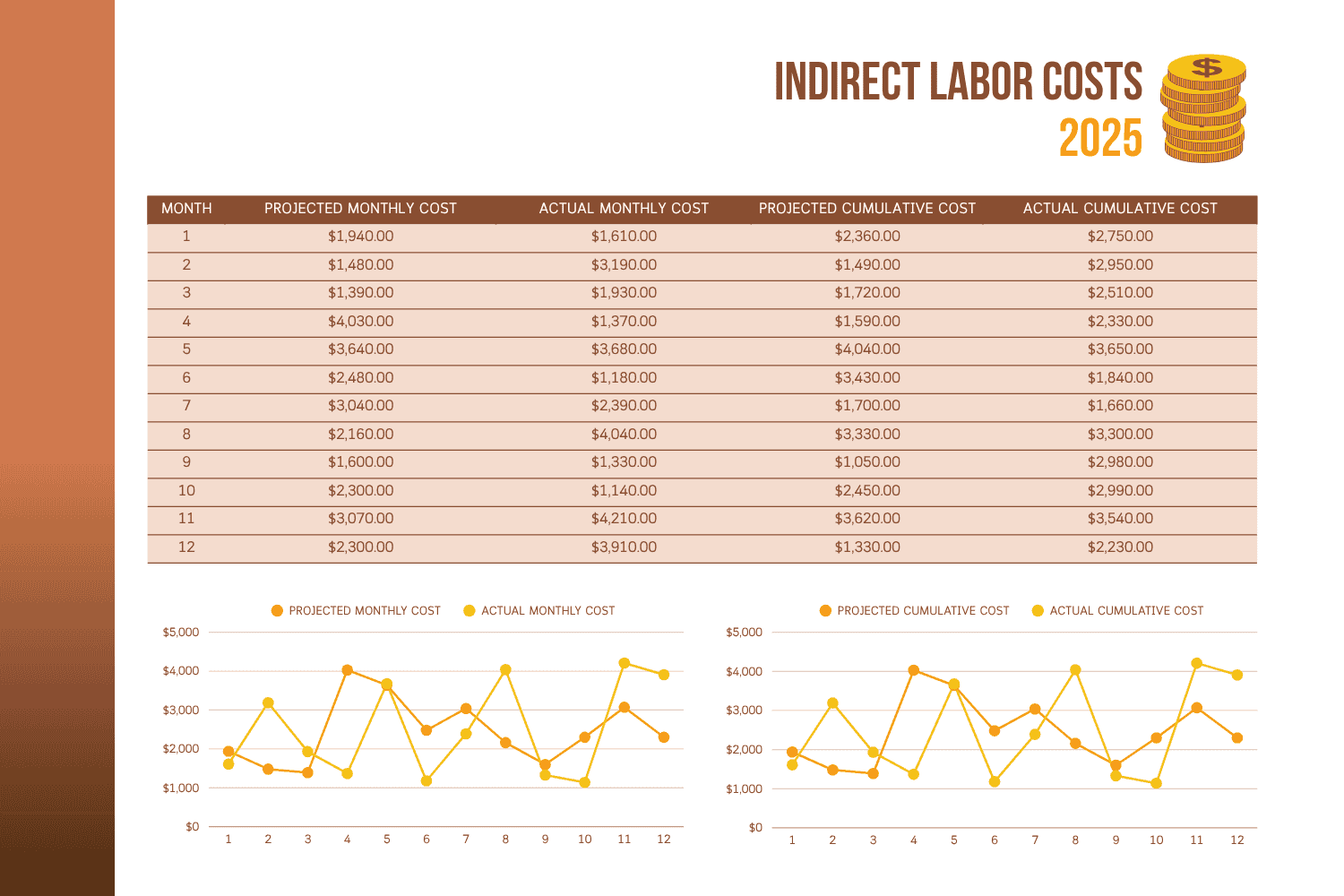
- What is Indirect Labor Cost?
- Why is indirect labor important to understand?
Indirect labor allocation determines who the company needs to hire to increase efficiency. Companies include indirect labor costs in their budgets if they need additional help outside of the production team.
How we verified this
We cross-referenced public data (BLS, SBA, Federal Reserve, major industry reports) against our own review of this topic. Where specific numbers appear, we link the primary source. Where sources disagree, we note the discrepancy rather than pick a single figure.
Key Takeaways
- Indirect labor includes supervisors, quality control, purchasing staff, and other roles that support production without building products directly.
- These costs are charged to factory overhead and then allocated to production units, ending up in inventory or cost of goods sold.
- Administrative indirect labor (accounting, marketing, engineering) is expensed immediately rather than allocated to production units.
If a company outlines the specific functions that need help, they are more likely to streamline business operations and achieve their goals.
What is Indirect Labor Cost?
Indirect labor costs are wages for tasks that support production but aren’t directly involved in making products. Examples include roles like production supervisors, purchasing staff, and quality control staff. Factory overhead is charged with these costs.
They are then allocated to the production units made during the reporting period. Thus, they end up in ending inventory or the cost of goods sold.
Indirect labor also covers administrative roles like accounting, marketing, or engineering. Costs from these jobs don’t trace directly to production, so they’re charged as expenses when they occur. Indirect labor costs also cover benefits and payroll taxes.
These are considered for financial analysis or cost accounting.
Such roles include janitors, foremen, and security guards who support the facility but do not make goods. Other examples are managers, accountants, and maintenance staff, all of whom engage in indirect labor.
Why is indirect labor important to understand?
Indirect labor costs are crucial for a company’s success. Companies must understand the importance of indirect labor because it helps calculate the company’s profitability and help set the price of products and services.
For example, if a company hires an accountant, they are responsible for analyzing reports that document financial transactions for the entire company. Once they have documented the company’s transactions from all departments, they can determine if the company is performing well and can make recommendations on how to proceed with spending.
Accountants are indirect labor because they make decisions that affect the company’s Accountants are considered indirect labor because they influence company performance without producing goods or services. The accountant’s annual salary is an indirect labor cost for employees who help organizations identify how they will control spending going forward.
Recognizing the role of indirect labor helps companies calculate overhead costs for their products and services. They can add up all overhead costs and add up the cost per unit sold.
This calculation helps companies measure the final cost charged to customers. There may be an increase in the cost of the product because you are adding overhead costs to the cost of production. A company may need to charge more for a product so that they can compensate for all the indirect labor costs of the employees.
What is the Difference Between Indirect and Direct Labor Cost?
Direct labor is the cost associated with producing products and services. Companies calculate direct labor costs by the hours of work required to create products for customers.
Indirect labor does not involve the production process. It is instead charged as a cost to employees who assist in other areas of the organization.
How to Calculate Indirect Labor Cost
Here are the steps to calculate indirect labor costs:
1. Identify the number of employee working hours
Figure out the number of hours each employee worked on indirect labor costs to begin your calculation. Recording the number of hours employees worked shows how much time they spent on tasks other than production.
Accountants can look at their accounting software and accounting records to find the number of hours worked by employees in each department. They can separate employees who work in production and in other departments to make an accurate calculation of the number of indirect labor hours.
2. Reduce break time for each employee
Factor in paid time off if paid time off is part of an employee’s compensation package. This ensures it is not counted as hours worked, improving the accuracy of calculations.
Employees may have paid sick leave or be paid for training or conferences they must attend on behalf of the company, which would also not be included in the indirect labor calculation.
3. Multiply the total hours worked by hourly employees by their hourly wage.
Multiply the number of hours an hourly employee works per year by their hourly wage. Making this calculation helps companies understand how much they are paying in indirect labor costs for one employee.
If the employee worked 1,715 total hours last year for $15 per hour, multiply 1,715 by $15,000, and you are paying $25,725 per year for one employee. Repeat this calculation for all hourly employees to include in your indirect labor costs.
4. Add the employee’s annual salary to your calculations.
Include the annual salary for salaried employees in the company’s calculations. Ensure this is done after completing steps one through four. This enables a comparison of total indirect labor costs for both hourly and salaried employees.
Determine the number of salaried employees in the organization for this calculation.
Examples of Indirect Labor Cost
The following is an example of indirect labor costs:
Production Manager
Production managers oversee staff employees to ensure all aspects of a project are completed on time. They provide clear instructions and expectations to employees about the production process and the steps they need to take to complete their tasks.
They can inform employees about project scope adjustments if the customer communicates them to them.
Security
A security guard ensures that the workspace is safe for employees to perform their duties. They may patrol around the building to identify suspicious activity and if it poses a threat to employees. They may work morning or evening shifts to watch over the building 24 hours a day.
Marketing
Marketing employees promote the company’s products and services after they are launched to the public. They produce and publish content on their company’s social media pages, and they optimize it so that users can find it in search engine results pages ( SERPs).
Marketing professionals monitor engagement performance to see if they are reaching their target audience and make adjustments to their company’s marketing strategy based on the results they gather.
Human Resources
Human resources staff are responsible for recruiting, interviewing, and hiring employees for different departments. They determine the appropriate payroll and benefits structure to compensate employees and coordinate with management on best practices for training and developing employee performance. Human resources may update employee handbooks to reflect company policies.
Putting it together
That’s a complete discussion of indirect labor cost and how to calculate it in your business bookkeeping process. If you are a business owner who produces a product, of course you are used to calculating this cost.
To make it easier for you to record and calculate all costs incurred in your business, you can use accounting software that has the most complete features such as Billed and Agiled.
When this guide isn't for you
This is written for owner-operators and small teams doing their own books or working with a bookkeeper. If you run a regulated industry with complex consolidation (multi-entity real estate, SaaS with deferred revenue at scale, medical billing with specific payer rules), you probably need a specialist accountant and an ERP rather than a general small-business approach.
Frequently Asked Questions
What is the difference between direct and indirect labor costs?
Direct labor costs are wages paid to employees who physically produce a product or deliver a service to a client, while indirect labor costs cover support roles like supervisors, maintenance staff, and quality control. The key distinction is whether the work can be traced directly to a specific unit of output.
How do you allocate indirect labor costs to products?
Indirect labor costs are typically allocated using an overhead rate based on direct labor hours, machine hours, or direct labor cost. For example, if total indirect labor is $50,000 and total direct labor hours are 10,000, each product hour receives $5 in indirect labor allocation.
Are administrative salaries considered indirect labor costs?
Administrative salaries such as those for HR, accounting, and executive staff are generally classified as general and administrative expenses rather than indirect labor costs. Indirect labor specifically refers to support roles within the production or service delivery process, not corporate overhead functions.
Related resources: See also our guide on direct labor cost and learn how Billed's time tracking helps you track labor costs accurately.