
- What is the general ledger?
- What do you need the general ledger for?
The general ledger is crucial to a company’s accounting system. It organizes and records economic activities in a structured way. This helps in assessing the company’s financial health.
Key Takeaways
- The general ledger is crucial to a company’s accounting system.
- Understanding a general ledger helps businesses make informed financial decisions and stay compliant.
- Maintaining the general ledger is an ongoing process consisting of several steps.
Learn about the connection between the general ledger and journal in double-entry accounting. Discover how to create and read a general ledger.
What is the general ledger?
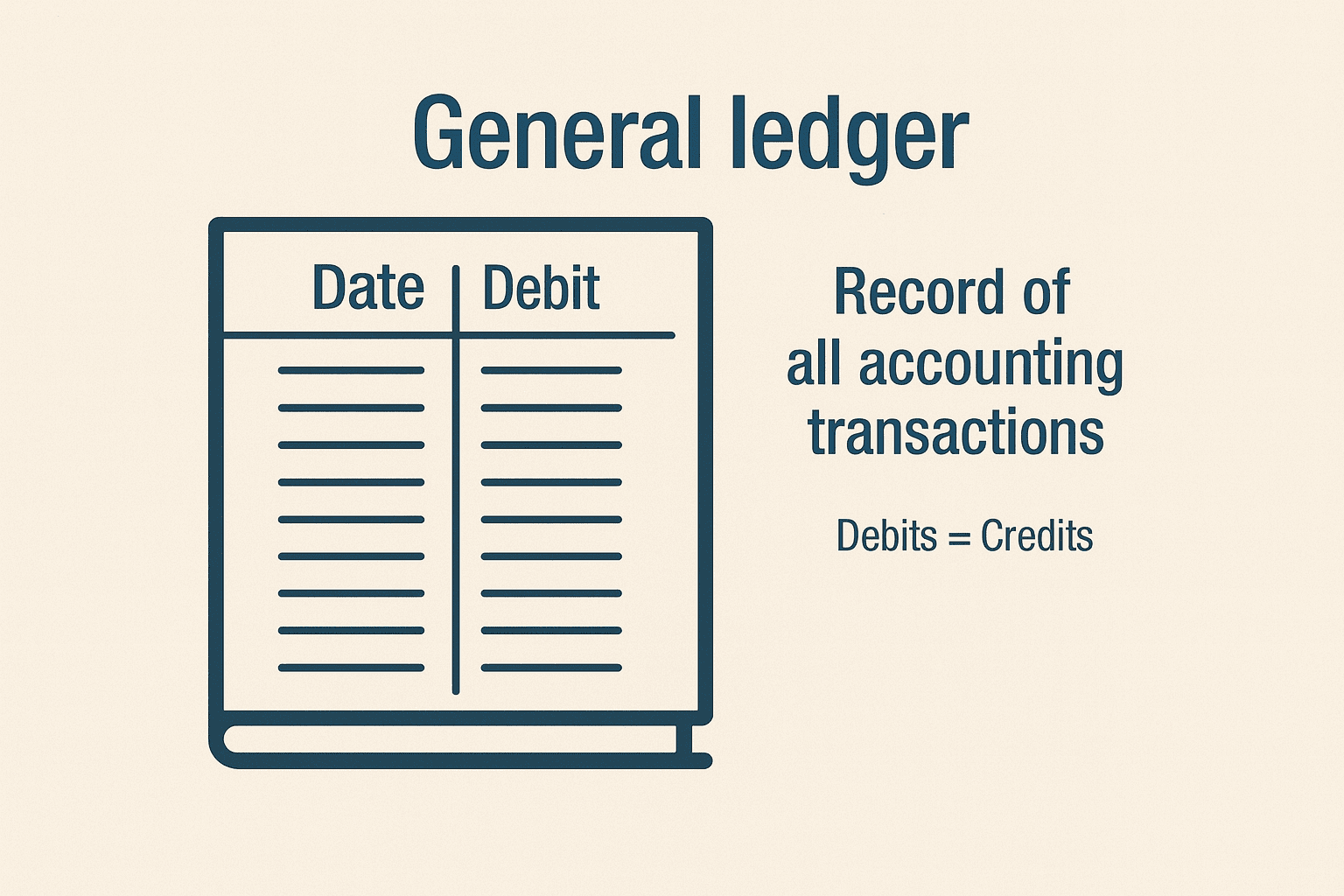
The general ledger contains all postings for a fiscal year, sorted by subject matter. In this ledger, all business transactions are assigned to their respective subject areas—for example, “Materials,” “Receivables,” or “Cash.” In double-entry bookkeeping, the general ledger is the counterpart to the journal, which also records all postings, but in chronological order.
What do you need the general ledger for?
At the end of each business period, usually once a year, you close all accounts. This involves preparing the balance sheet and the profit and loss statement, in SwitzerlandIncome statementPotential investors interested in your company primarily consult these two sources of information because they reflect the company’s assets and liabilities.
Experts use these statements to draw detailed conclusions about the health of your company. This is important for investors and other creditors the basis for deciding for or against your company. However, the balance sheet and income statement are also decisive for the state, because they are the basis for determining Federal Tax Administration the taxes to be paid.
The legislator therefore regulates the prescribed minimum requirements that you must meet when preparing your annual financial statements must fulfill.
What are the differences between journal, general ledger and subsidiary ledger?
In accounting there are different types of books (or simply “records”) that are used to track various aspects of a company’s finances. These include the journal, the general ledger, and the subsidiary ledgers.
Journal
The booking journal is commonly known as the general ledger. It is the book in which you first record all business transactions, in chronological order and as double-entry accounting entries. You can think of it as a diary for everything related to your company’s finances.
Important: After a transaction is recorded in the journal, it is also transferred to the corresponding accounts in the general ledger.
General Ledger
The general ledger is the central ledger in accounting. It contains all the accounts in which you record business transactions. There is no universally accepted definition of what a general ledger must contain.
Which accounts are included in a general ledger differs from company to company and depends on the specific business transactions.
For example, at Company A, the “Fleet” account may be very extensive, while at Company B, it doesn’t exist at all because it doesn’t have company cars.
The general ledger records changes across all accounts. Each account represents a specific category, such as assets (like cash and demands), commitments (like loans and trade payables), equity capital, income, or expenditure.
Subsidiary Ledgers
Subsidiary ledgers complement the general ledger and allow for more detailed tracking of specific transactions. They record information about specific types of transactions, which are then summarized in the accounts in the general ledger.
For example, if you have a subsidiary ledger for customer receivables, you record in this ledger every single transaction in which debtors you owe money (for example, after a sale on account). This subsidiary ledger is linked to the “Accounts Receivable” account in the general ledger. For your supplier accounts payable, i.e., where you owe money to your creditors, you maintain another subsidiary ledger in which you record what you have to pay, to whom, and when.
Relationship between General Ledger and Subsidiary Ledger
The general ledger and the subsidiary ledgers complement each other and together provide a comprehensive picture of the company’s finances.
Imagine your general ledger as a city map. Each account in the general ledger (cash, assets, liabilities, income, etc.) is a street on that map. You can see where each street is located relative to the others, but you can’t see in detail what’s happening “on the street.”
This is where the subsidiary ledgers come in. Each subsidiary ledger is like a close-up view of every street. In these close-ups, you can see every house, every sidewalk, and every car that is currently driving somewhere or stuck in traffic.
Financial accountingThis means that each sub-ledger provides detailed information about a specific type of transaction.
Together, the general ledger and subsidiary ledgers provide both a bird’s-eye view and a close-up view of your finances. They help you understand and manage your business’s overall situation.
How is the general ledger maintained?
Maintaining the general ledger is an ongoing process consisting of several steps. Using a specific example best illustrates this process.
If you run a small cafe and purchase new coffee machines worth $5,000. You record this transaction as follows:
The transaction is recorded in the ledger register. You spent $5,000 and received business equipment worth $5,000 (operating and business equipment). Since the land register records all transactions as ongoing entries (i.e., in chronological order), you enter them one after the other in the form of a numbered list:
Land Register
| Sr. | Entry | Debit | Credit |
|---|---|---|---|
| 1 | BGA a Bank | $5000 | $5000 |
| 2 |
Next, transfer the transaction to the general ledger. Two accounts are affected: the “BGA” account and the “Bank” account. Increase BGA by $5,000 because you have new business equipment (“Active”) for your cafe in this amount.
At the same time, you reduce the “Bank” account by $5,000, as you have purchased this amount (Liabilities).
The general ledger uses T-accounts to display accounts. These have a debit side and a credit side on the table. This is what the T-form ledger looks like.
General Ledger
BGA
Bank
Debit CreditAB $5000 Bank $5000
Debit Credit AB $75000 BGA $5000
“AB” stands for “opening balance” and represents the starting value of an account at the start of a new accounting period. In the case of the BGA account, for example, it means that the cafe already had operating and business equipment valued at $50,000 before the new coffee machines, valued at $5,000, were added.
You should assign each of these two entries the booking number assigned to the transaction in the land register – in this example, “1.” You should also note which other account is being used for each booking. For example, if the booking is made to the “BGA” account, note that this booking also applies to the “Bank” account, because the purchased BGA is paid for with money from the bank.
The accounting remains balanced due to these two entries in the general ledger. In accounting, the sum of assets (in this case, operating and business equipment and bank balances) is always equal to the sum of liabilities and equity. This principle is known as “double-entry bookkeeping“.
At the end of a financial year will all posting entries from the land register to the individual general ledger accounts. You can then “close” the accounts. To do this, add the larger side and note the total on the opposite side.
You then transfer the resulting balance of each account to the SBK (closing balance account). You then create your final balance.
General Ledger
BGA
Bank
Debit CreditAB $50000Bank $5000 Balance $55000 $55000 $55000
Debit Credit AB $75000 BGA $5000 Balance $70000
$75000 $75000
The balance of an account refers to the final amount in an account after all debit and credit entries for a specific accounting period have been settled. You calculate the balance by comparing the total of all debit entries with the total of all credit entries. Depending on which is greater, it is referred to as a debit balance or a credit balance.
What does the principle of closure mean for the main account?
The principle of formal and material closure in accounting refers to the process by which all accounts are closed or “closed” at the end of an accounting period (often the end of a fiscal year). This closure serves to prepare the general ledger for the beginning of the next accounting period.
“Formal” integrity requires the debit and credit of each account to be balanced. This means that when the general ledger is closed, the total debits and credits must be equal.
. “Material” integrity means that you must completely record all business transactions for an accounting period in the general ledger.
Closing accounts involves three steps:
- First, you close all sales and expense accounts: You set the balances of these accounts to zero by making a balancing entry. The difference between the sales and the expenses, i.e. the profit or loss, are then transferred to the equity account.
- Next, you close any dividends or withdrawals by transferring the balance of those accounts to the equity account as well.
- To close the equity account, transfer the balance to the new fiscal year. This starts the new fiscal year with the opening balance sheet.
Closure is a key principle in financial statements for accounting. It ensures accounts are zeroed at the end of one period and ready for transactions in the next. Furthermore, this principle ensures that a company’s profit or loss is correctly transferred to the equity account, providing an accurate picture of its financial position.
Maintaining a general ledger requires accuracy and attention to detail. Ensuring all transactions are recorded and classified correctly not only helps manage your company’s finances, but is also crucial for tax compliance and presenting accurate financial information to investors, banks, and other stakeholders.
FAQs
How many accounts are there in a general ledger?
The number of accounts in a general ledger can vary greatly depending on the size and complexity of the business. There can be as few as a few dozen accounts or as many as thousands. Therefore, each business has a unique general ledger that meets its specific needs.
What is the role of the general ledger in accounting?
It plays a central role in accounting by clearly assigning all business transactions to the relevant accounts. This assignment ensures a clear presentation of income and expenses, which in turn facilitates the preparation of accurate balance sheets and reports.
What are the important features of the general ledger?
Here are some of the important features:
- It divides business transactions into general ledger accounts.
- It forms the basis for the annual financial statements and the profit and loss account (P&L).
- It summarizes the company’s financial position at any given moment.
Related resources: Learn about debit and credit and explore trial balance for a complete picture of your financial records.