
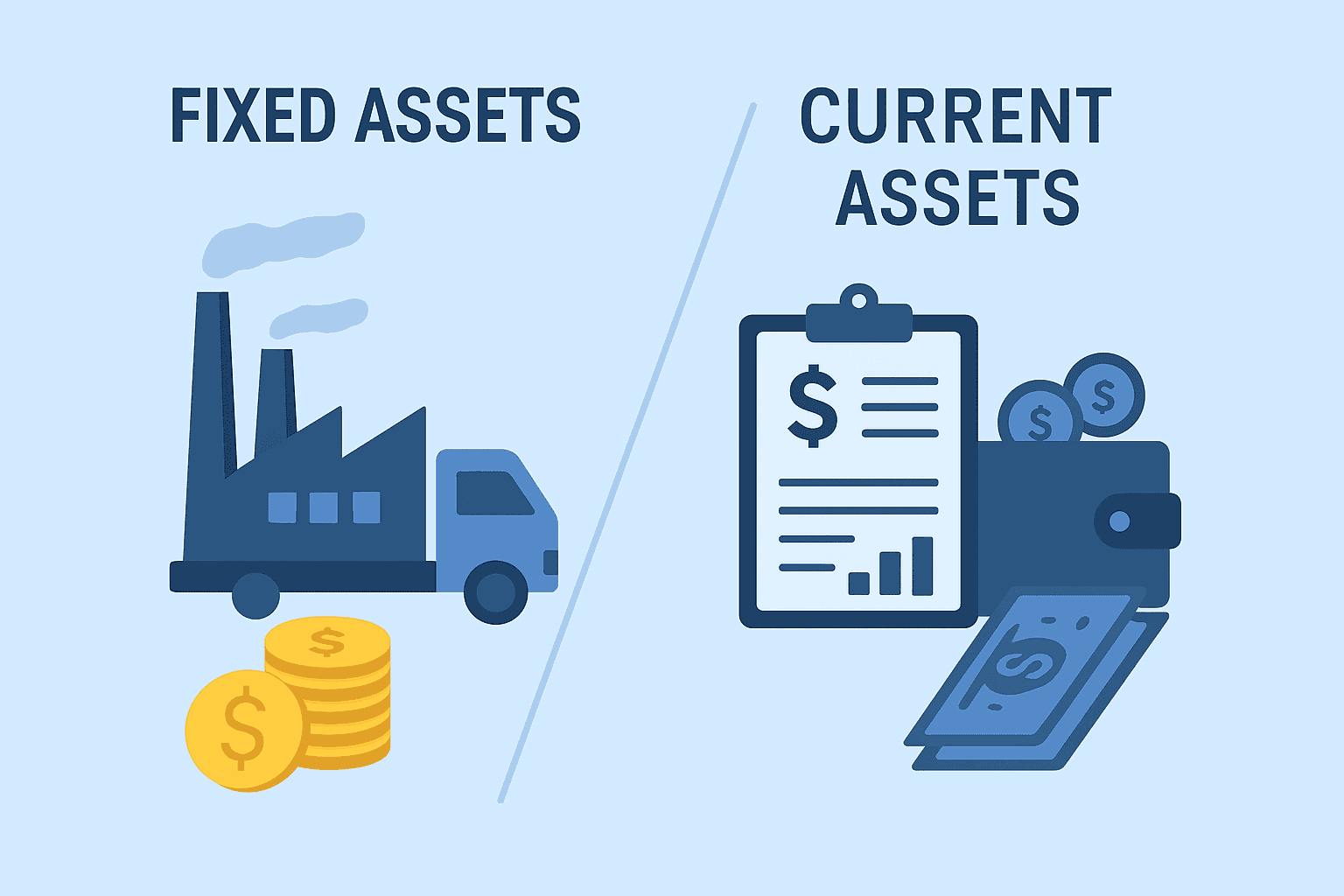
- Definition of fixed assets and current assets
- The key elements of fixed assets
Current assets or fixed assets? These two concepts are often a bit vague. They’re used in corporate accounting and aren’t necessarily immediately clear to everyone.
| Aspect | Fixed assets | Current assets |
|---|---|---|
| Time horizon | Used for more than one year | Convertible to cash within one year |
| Examples | Buildings, machinery, vehicles, computers | Cash, accounts receivable, inventory, prepaid expenses |
| Balance sheet location | Non-current assets | Current assets |
| Depreciated? | Yes (except land) | No |
| Liquidity | Low | High |
| Affects | Long-term capital planning | Working capital and short-term liquidity |
How we verified this
We cross-referenced public data (BLS, SBA, Federal Reserve, major industry reports) against our own review of this topic. Where specific numbers appear, we link the primary source. Where sources disagree, we note the discrepancy rather than pick a single figure.
Key Takeaways
- Fixed assets (buildings, machinery, vehicles) have useful lives beyond one year, large investment amounts, and long depreciation cycles.
- Current assets (cash, receivables, inventory) are highly liquid and can be converted to cash within one year.
- Balancing both asset types is critical: fixed assets drive long-term capacity while current assets fund daily operations and cover short-term obligations.
What are current assets and fixed assets? What are the differences between them? We’ll explain everything so that the distinction is now simple.
Definition of fixed assets and current assets
Fixed assets refer to resources that are put into operation for long-term benefits, usually various tangible fixed assets with a useful life of more than one year, such as various machinery, equipment, houses, cars, factories, workshops, etc. These assets not only have long-term use value, but also have large investment amounts and long depreciation cycles, so they are generally not sold or liquidated in a short period of time.
Current assets are used in daily business activities. They can be quickly converted into cash or cash equivalents. This typically includes deposits, cash, notes receivable, accounts receivable, short-term investments, and inventories.
These assets are highly liquid. They usually involve small investment amounts and short depreciation cycles.
The key elements of fixed assets
In accounting, fixed assets are the fact, for the company, of holding an asset on a long-term basis, i.e. For more than one year and without the objective of reselling it subsequently.
Fixed assets are divided into three subcategories:
- Intangible assets: These are intangible assets, meaning they have no physical dimension. They cannot be touched. For example, the registration of a patent or trademark, or goodwill, are intangible assets.
- Tangible fixed assets: These are tangible assets. They can be touched. They are non-monetary assets. These include company furniture, tools, industrial equipment, land, buildings, etc.
- Financial fixed assets: These are monetary assets. These are the company’s financial securities (shares, stocks), the company’s share capital, loans granted by the company, etc. These assets result from financial transactions recorded in the company’s balance sheet.
The constituent elements of current assets
Current assets are divided into three categories:
- inventories**,** which are all goods purchased or created by the company and intended for sale or consumption for production purposes.
- prepaid expenses, i.e. Goods and services purchased by the company whose supply or production will take place at a later date. For example, raw materials awaiting delivery or insurance paid at the end of the year for the following year.
- receivables, i.e., amounts owed by the company’s customers. These customer receivables represent future resources for the company. These may be late payments from customers, or payment schedules that provide for payment in the next accounting year, or payments spread over several fiscal years.
Why are current assets and fixed assets reported separately in financial statements?
Calculation of current assets
A company’s financing needs are assessed using current assets. This need can be:
- in the short term: to build up stocks, grant payment terms to customers, etc.
- or immediate: building up cash to manage daily expenses.
The value of current assets changes as the company’s activity progresses. Knowing current assets and knowing how to calculate them are therefore essential for understanding and anticipating your company’s activity. These current assets correspond to an operating need and are constantly evolving.
Indeed, it is essential to control all the elements constituting current assets. This allows you to have sufficient short-term financing so as not to penalize your company’s activity.
The balance sheet contains the data needed to calculate current assets, which is crucial for determining accounting results. Key elements to consider include inventories of goods, raw materials, intermediate products, finished products, work in progress, services, and customer receivables. Calculating current assets involves adding together all inventory and customer receivables.
The usefulness of current assets
Current assets are financed by resources of the same nature, called current liabilities. These current liabilities consist of operating debts (supplier debts), tax debts, and social security debts.
To determine the working capital requirement, calculate the difference between current assets and current liabilities. This represents a company’s short-term financing needs that result from cash flow mismatches corresponding to revenues and expenses.
Finally, Current assets help calculate financial ratios, like the general liquidity ratio. This ratio assesses a company’s capacity to settle short-term debts. It is calculated by dividing current assets by short-term debts.
A ratio greater than 1 indicates that the company is solvent. Conversely, a ratio less than 1 suggests the company struggles to repay its debts.
Calculation of fixed assets
Fixed assets are valued at their acquisition cost. Their depreciation overtime must be taken into account when they are depreciated or in the case of a provision for risks. In fact depreciation measures the annual loss in value of a fixed asset caused by its wear and tear.
The calculation of gross fixed assets is done in this way:
Gross fixed assets = tangible fixed assets + intangible fixed assets + financial fixed assets
Fixed assets can also be calculated at their net amount to take into account the use of depreciable assets and their wear and tear or obsolescence. In this case, the calculation is done as follows:
Net fixed assets = gross fixed assets – depreciation of tangible and intangible fixed assets – depreciation of fixed assets
Usefulness of fixed assets
The usefulness of fixed assets varies depending on the type of activity carried out. Thus, in manufacturing companies, fixed assets represent a significant portion of total assets. These companies have significant investment needs.
In service companies (such as IT service providers), however, it will not be significant. Companies with significant financial assets are often holding companies, whose business is to manage a portfolio of holdings. A holding company is designed to own shares and stocks in one or more companies.
The interest in fixed assets also comes from the calculation of net working capital (NWC). This financial indicator is important for determining whether the company has a balanced financial structure.
Other ratios can also be determined, such as the wear rate. This rate is used to calculate the degree of wear and tear of a company’s production tools or the financing of fixed assets. Its calculation determines a company’s sustainable resources.
It is obtained by: net fixed assets/gross fixed assets.
So, once understood, these two concepts are very useful for reading and maintaining your company’s accounts. However, it remains technical and can represent too restrictive a complexity when you have a thousand things to manage at the same time. So, to lighten your work by saving you time, software like Billed, and Agiled offers to automate accounting entries as well as the calculations of balance sheet items.
In this way, you have real-time access to your company’s dashboards, and you can manage your activity with complete peace of mind.
What is another name for net assets?
A company’s net assets are its assets minus its liabilities. They are also known as book value or shareholders’ equity.
What type of asset is a machine?
A fixed asset refers to a machine, building, or truck used in a business’s operations. These assets are long-term and have a useful life of more than one year.
What is the main difference between fixed assets and current assets?
Among all assets, it is necessary to distinguish between fixed assets. These assets are part of the company’s long-term assets (goodwill, equipment in particular) and current assets. These include stocks, receivables, and the bank account balance.
Related Artilces:
- Expense Account in Business: A Beginner’s Guide
- Sample Balance Sheet and Income Statement for Small Business
When this guide isn't for you
This is written for owner-operators and small teams doing their own books or working with a bookkeeper. If you run a regulated industry with complex consolidation (multi-entity real estate, SaaS with deferred revenue at scale, medical billing with specific payer rules), you probably need a specialist accountant and an ERP rather than a general small-business approach.
Frequently Asked Questions
Why are fixed assets and current assets listed separately on the balance sheet?
They are listed separately because they serve different purposes and have different liquidity levels. Current assets are expected to be converted to cash within one year and reflect short-term financial health, while fixed assets represent long-term investments used to generate revenue over multiple years.
Can an asset be reclassified from fixed to current?
Yes, a fixed asset can be reclassified as a current asset if the business intends to sell it within the next 12 months. For example, a piece of equipment that is being retired and put up for sale would move from fixed assets to current assets on the balance sheet.
What are some common examples of current assets and fixed assets?
Common current assets include cash, accounts receivable, inventory, and prepaid expenses. Fixed assets typically include property, buildings, machinery, vehicles, and office equipment that are used in operations for more than one year.