
- Before the client signs: withdrawing or replacing a quote
- When the client can cancel: cooling-off rules
Once a client signs your quote, you may both be bound by a contract, and neither of you can simply tear it up. A quote that sets out the work and the price is an offer. When the client accepts it, the result can be a binding contract, and the person who made the offer generally can't take it back after acceptance (Cornell LII, "offer").
A signed quote can still be canceled in four situations:
- The quote or contract says so. A cancellation clause sets out when either side can end the job and what is owed.
- You both agree. Mutual cancellation ends both sides' obligations (Cornell LII, "rescission").
- The client has a legal cooling-off right. Consumer laws give buyers a short window to cancel certain sales made away from your business premises (see the US and UK rules below).
- The other side has seriously broken the deal, or performance has become impossible. These are narrow legal grounds, and a mistake about them can turn your cancellation into the breach.
Everything else turns on your contract terms and the law where you and your client are. The general principles below come from US legal sources. Contract law in other countries differs in detail, so talk to a lawyer where you work before you cancel a job that's worth more than you can afford to lose.
Before the client signs: withdrawing or replacing a quote
Until the client accepts, you're free to withdraw. US contract law lets the person who made an offer withdraw it by telling the other side before they accept, unless they have agreed to keep it open, for example in an option contract (Cornell LII, "offer"). In practice:
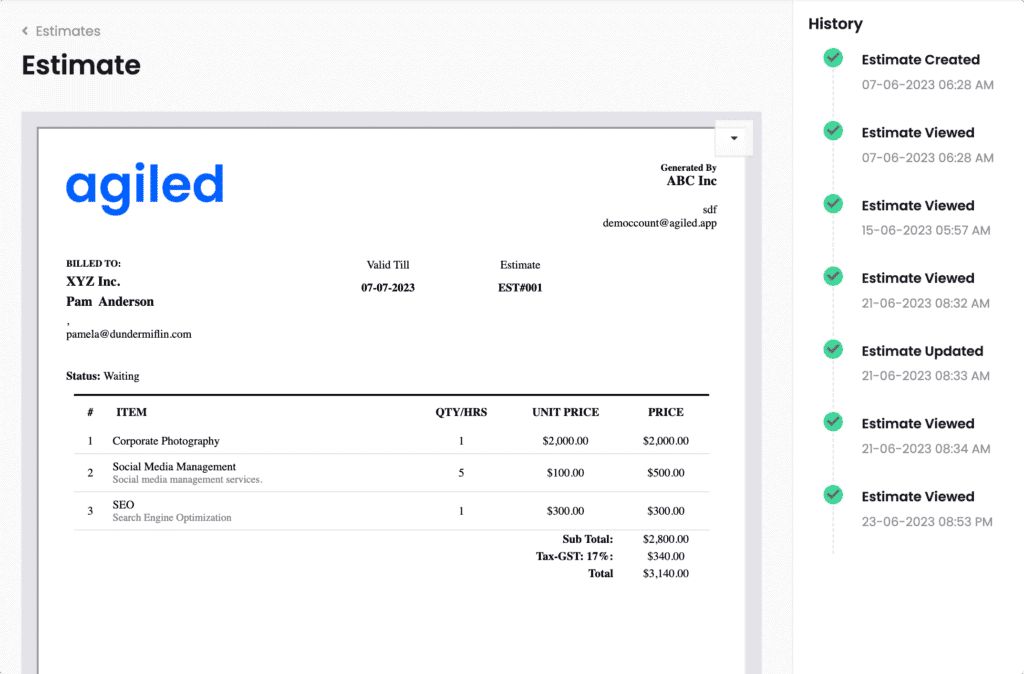
- To correct a quote, send a new one that states it replaces the earlier quote by number, and tell the client the old one is withdrawn.
- Put an expiry date on every quote. An offer that isn't accepted in time lapses (Cornell LII, "lapse"). If a client signs after the date on your quote, you can accept at the old price, send an updated quote, or decline.
- Watch for counter-signed changes. If the client crosses out a line or changes the price before signing, that's a counteroffer, not an acceptance of your quote (Cornell LII, "offer"). Nothing is agreed until you accept their version.
Whether your document is called a quote or an estimate matters less than what it says and what the client signed. See estimate vs quote vs proposal for how the terms are used, and how to create an estimate for the details worth including.
When the client can cancel: cooling-off rules
In the US: the FTC Cooling-Off Rule
If you sell to consumers at their home, a federal cooling-off right may apply. Under the FTC's Cooling-Off Rule (16 CFR Part 429), a "door-to-door sale" covers consumer goods or services bought primarily for personal, family or household purposes when you personally solicit the sale and the buyer agrees to buy somewhere other than your place of business. It applies even when the buyer invited you, and the purchase price must be:
- $25 or more for a sale made at the buyer's home; or
- $130 or more for a sale made at other places, such as hotel rooms, convention centers, fairgrounds or the buyer's workplace.
The buyer can cancel until midnight of the third business day after the sale, and doesn't have to give a reason (FTC consumer guide). Saturday counts as a business day. Sundays and federal holidays don't (16 CFR 429.0(f)).
If the rule applies, you as the seller must (16 CFR 429.1):
- give the buyer a copy of the signed contract or a receipt with the cancellation statement printed next to the signature space;
- attach a completed "Notice of Cancellation" form in duplicate;
- tell the buyer out loud about their right to cancel;
- leave out any waiver of that right; and
- if the buyer cancels, refund all payments within 10 business days of receiving their notice.
The rule doesn't cover purchases for business use. It also doesn't cover sales negotiated earlier at your permanent shop or showroom, or sales made entirely by mail or phone with no other contact. A repair or maintenance visit the buyer asked for is outside the rule, but anything extra you sell on that visit is covered. A genuine emergency is also excluded, but only if the buyer started the contact and gives you a separate, dated, handwritten statement waiving the right. Real estate, insurance and securities are excluded too (16 CFR 429.0(a)).
State law can give buyers more rights than the federal rule, and the FTC rule doesn't override state laws that do (16 CFR 429.2). Check with your state attorney general or consumer protection office.
In the UK: the Consumer Contracts Regulations
In the UK, the Consumer Contracts (Information, Cancellation and Additional Charges) Regulations 2013 give consumers a right to cancel "off-premises" contracts and distance contracts. An off-premises contract includes a contract agreed in person away from your business premises, such as at the client's home (regulation 5). A consumer is an individual acting wholly or mainly outside their trade or profession (regulation 4).
- 14 days for services. The consumer can cancel without giving a reason (regulation 29). For a service contract, the period ends 14 days after the day the contract was made (regulation 30).
- Up to 12 months longer if you don't explain the right. If you don't give the required cancellation information, the period can run up to 12 months beyond the normal end date (regulation 31).
- Starting work early. You must not start the service within the cancellation period unless the consumer expressly asks you to; for off-premises contracts, that request must be on a durable medium. If they asked and then cancel, they pay a proportionate amount for the work done. If they didn't ask, or you didn't give them the required information, they pay nothing for it (regulation 36).
- Refunds. Refunds are due without undue delay and, for services, no later than 14 days after you're told about the cancellation (regulation 34).
- Exclusions. Exclusions include off-premises contracts of £42 or less (regulation 27), urgent repairs or maintenance that the consumer specifically called you out for, and goods made to the consumer's specifications (regulation 28).
Other countries have their own consumer cancellation rules. None of the figures above apply outside the US or UK.
When you can cancel after the client has signed
As the business, you have no cooling-off right of your own. You can end a signed job in these situations:
- Your contract gives you the right. For example, you can cancel if the deposit isn't paid by a set date or the site isn't ready by an agreed date. A right you wrote in before signing is far easier to rely on than one you argue for afterwards.
- The client agrees. This is the cleanest route when you find a pricing error after signature. Explain the error, offer a corrected quote, and get the client's agreement in writing to cancel the old one. If they say no, the signed quote stands.
- The client has seriously broken the contract. A party can cancel because of the other side's material breach, fraud, duress or misrepresentation (Cornell LII, "rescission"). Examples are not paying a stage payment that is due, or refusing access to the site. Keep the emails and messages that show what happened. Whether a breach is serious enough is a legal judgment, so get advice before relying on it.
- Performance has become impossible. In US contract law, an unforeseen event after the contract was made that makes performance impossible can excuse it (Cornell LII, "impossibility"). A force majeure clause can cover named events such as fires, floods or storms. But "mere impracticality or unanticipated difficulty is not enough," and courts generally don't treat an economic downturn as force majeure (Cornell LII, "force majeure"). A supplier raising prices, or a better-paying job coming along, is not a valid reason to cancel.
What happens if a signed quote is canceled without a right to cancel
Canceling without a right is a breach of contract, and this applies to you or the client alike. The default remedy is money: contract law aims to put the harmed party in the position they would have been in if the contract had been carried out (Cornell LII, "breach of contract"; "expectation damages").
- If you walk away, the client's claim starts from the extra cost of getting the same work done by someone else, plus the return of anything they paid you for work you didn't do.
- If the client walks away, your claim starts from what you lose: costs you can't recover and the profit you would have made. You have a duty to limit your losses. In the classic US case, a builder who kept working on a bridge after the county told it to stop couldn't recover for the extra work (Cornell LII, "mitigation of damages"). Once a client tells you they're canceling, stop work and stop ordering materials.
- A set cancellation fee in your quote works as a liquidated damages clause. Courts won't enforce one that is punitive or unconscionable (Cornell LII, "liquidated damages"), so base it on your real costs.
Change order or cancellation?
A request to "cancel the quote" can really be about changes to the job. If the client wants more, less or different work, or you've found something on site that changes the price, a signed change order is the better route. It keeps the original agreement and records the new scope and price. Canceling ends the agreement outright.
Use a change order when both sides still want the job done. Cancel only when the job itself is off. See how to handle estimate revisions and how to handle scope creep.
Worked example: one signed bathroom quote, three outcomes
Sample facts for illustration only. They assume a US business, and that no federal holiday falls in the week. Ridgeline Tile & Bath, a fictional contractor, visits a homeowner who asked for a remodelling estimate. At the homeowner's kitchen table on a Monday, the homeowner signs Ridgeline's $9,600 quote for a bathroom remodel and pays a $1,500 deposit. The job is a planned remodel, not an emergency or a repair visit. The sale is made at the buyer's home and is well over $25, so the FTC Cooling-Off Rule applies. Ridgeline hands over the contract with the cancellation notice and two Notice of Cancellation forms, and explains the right out loud.
Outcome 1: the homeowner cancels on Wednesday. The third business day after Monday is Thursday, so a Wednesday notice is in time. Ridgeline must refund the full $1,500 within 10 business days. Suppose Ridgeline had already ordered a $640 custom vanity on Monday afternoon. That cost stays with Ridgeline, because the rule requires a refund of all payments. Lesson: don't start work or order special materials until the cancellation window has closed.
Outcome 2: the homeowner cancels after the window. The window closes at midnight on Thursday. On Friday, Ridgeline orders non-returnable special-order tile and a vanity for $1,180. The next week, before work starts, the homeowner cancels because of a change in their finances. Ridgeline's signed quote has this sample cancellation clause:
After the cancellation period, if you cancel before work starts, we refund your deposit less (a) the cost of non-returnable materials already ordered for your job, which we will deliver to you, and (b) design and measuring time at $85 an hour.
The settlement is:
| Item | Amount |
|---|---|
| Deposit received | $1,500 |
| Less non-returnable materials (supplier invoice attached) | −$1,180 |
| Less design and measuring time, 2 hours × $85 | −$170 |
| Refund due to homeowner | $150 |
Ridgeline stops all further ordering the day it gets the notice. It sends the homeowner an itemized statement with the supplier invoice, refunds $150 and delivers the materials, which the homeowner has now paid for. The clause is tied to costs Ridgeline can prove. That makes it far easier to defend than a flat fee that keeps the whole deposit regardless.
Outcome 3: Ridgeline wants out. Two weeks after signing, the tile supplier raises its price and Ridgeline's cost for the job goes up by $420. The quote has no price-adjustment clause, and a price rise isn't force majeure. Ridgeline has no right to cancel. It can absorb the $420, or ask the homeowner to agree to a change order, which the homeowner is free to refuse. Suppose Ridgeline cancels anyway and the homeowner hires another contractor for the same work at $10,400. The homeowner's claim would start from the $800 difference, plus the return of the $1,500 deposit. That's far more than the $420 Ridgeline was trying to avoid.
Cancellation terms worth putting in your quotes
The best time to settle cancellation is before anyone signs. Terms worth adding to your quotes:
- An expiry date ("valid for 30 days from the date of issue"), so an old quote can't be signed months later at an out-of-date price.
- Any statutory cancellation notice that applies, with the right forms for your country and state, and a rule not to start work or order special materials until that period has passed (or, in the UK, until the client has asked you to start in writing).
- A cancellation clause for each side that says what notice is needed, what happens to the deposit, and how work done and non-returnable materials are charged.
- A price-adjustment clause for materials with volatile prices, if you want the option to pass on increases.
- A change-order process, so a change in scope never needs a cancellation.
- A deposit that matches your early costs. See the guide to deposit invoicing and the deposit invoice template.
You can start from an estimate template or the contractor estimate template and add your own terms. For the wider contract, see freelance contract essentials and legal payment terms for invoices. If you need to refund part of an invoiced deposit, a credit note records it cleanly.
How to cancel a signed quote
Whichever side is canceling, and for whatever reason:
- Check the signed document first. Look for the cancellation clause, any notice period, and the date the cooling-off period ends, if one applies.
- Give notice in writing. Name the quote by number and date, state the ground you rely on (the clause, the client's agreement, or the breach), and give the date the cancellation takes effect.
- Stop work and stop ordering from the moment the cancellation is clear.
- Settle the money in writing. Send an itemized statement of the deposit, the costs that can be charged, and the refund or balance due. Attach the evidence.
- Keep the paper trail: the signed quote, the notices, the messages and the receipts.
If a client is going quiet rather than canceling, read how to follow up on estimates before treating the job as dead.
Frequently Asked Questions
Can a client cancel a quote after signing it?
Only if the contract allows it, you agree, or a law gives them a right to cancel. In the US, the FTC Cooling-Off Rule lets consumers cancel qualifying sales made at their home or at temporary locations until midnight of the third business day after the sale. In the UK, consumers have 14 days to cancel off-premises and distance service contracts. Outside those rights, a client who cancels without a contractual right may owe you for your losses.
Can I cancel a quote after the client has signed it?
Not on your own say-so. You can cancel if your contract gives you that right, if the client agrees in writing, or on narrow legal grounds such as the client's serious breach. A price increase from your supplier or a better offer elsewhere doesn't qualify. If you cancel without a right, the client can claim the extra cost of having the work done by someone else.
Do I have to refund a deposit if the client cancels?
Inside a legal cooling-off period, yes. The US FTC rule requires a refund of all payments within 10 business days, and the UK regulations require a refund within 14 days for services. A UK consumer who expressly asked you to start early pays a proportionate amount for the work done. Outside a cooling-off period, it depends on your contract terms and local law. A clause that deducts documented costs is easier to defend than one that keeps the whole deposit.
Can I withdraw a quote before the client signs it?
Generally yes. An offer can be withdrawn by telling the other side before they accept, unless you agreed to keep it open. Send a written withdrawal or a replacement quote that names the old one.
Should I cancel a signed quote when the scope changes?
No. Use a change order that both sides sign. It keeps the original agreement in place and records the new work and price, so the job continues without anyone having to cancel.