
Money Receipt Template: Deposits, Money Orders and Earnest Money
A money receipt confirms that a sum of money changed hands
No credit card required.
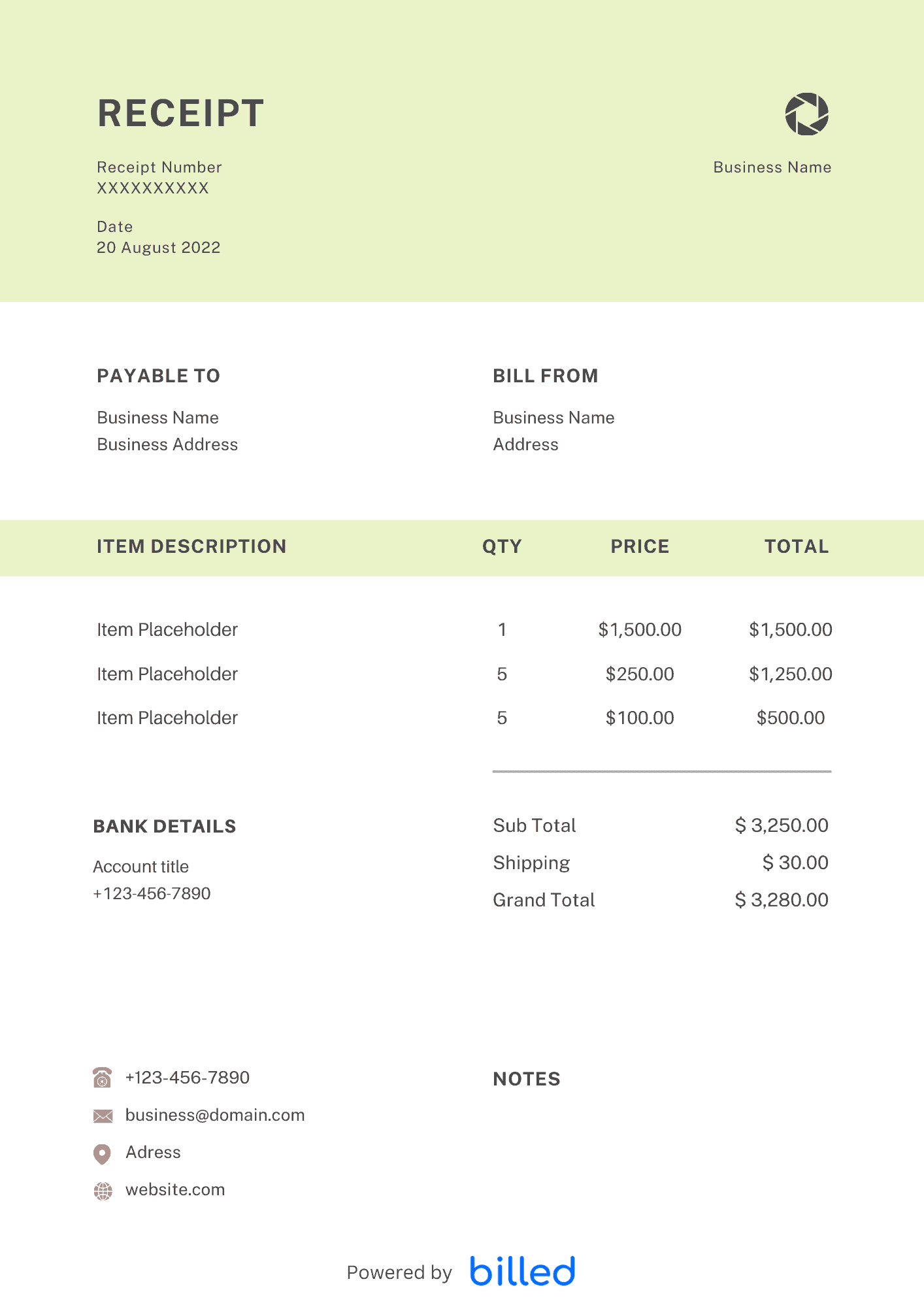
What a money receipt records
A money receipt confirms that one person or business received a sum of money from another. Here it covers three transactions that need more than an ordinary payment receipt: money deposits, payments made by money order, and earnest money. For an invoice payment, use the payment receipt; for a cash payment, the cash receipt. All names, numbers and amounts in the examples below are invented.
Billed publishes this page. The USPS quotes are from its Money Orders page as read on November 1, 2026. Treat this as general US information, not legal or tax advice.
The fields every money receipt needs
- Receipt number and date: a unique number, and the date the money was received.
- Payer: the payer's full name, or the business name if a business paid.
- Payee: the receiver's full name, or the business name if a business received it.
- Amount in figures and in words: for example, 650.00 and six hundred fifty dollars and 00/100. Write it both ways.
- How it was paid: cash, check (with its number), money order (with its serial number) or transfer (with its reference).
- Purpose: what the money is for, in the same words as the order or agreement it relates to.
- Place and signature: where the money changed hands, and the receiver's signature.
Close any section you leave empty with a line. For a plain signed receipt with the amount in words, use the payment acknowledgment layout on the acknowledgment receipt page.
Money deposit receipts
A money deposit is paid ahead of the balance, to reserve a date, goods or work to be done later. Beyond the basic fields, record:
- what the money holds, with its reference;
- the full fee, the deposit taken and what remains, with the date it's due;
- how the deposit will be credited, and the refund terms agreed with the payer, in the words you both accepted.
Example: Sample Hall takes a 600.00 deposit from Casey Example on November 6, 2026, to hold the hall for February 13, 2027. The full fee is 2,400.00, so the deposit is 25% (600.00 ÷ 2,400.00) and 1,800.00 remains, due by January 30, 2027. In words: six hundred dollars and 00/100.
Money order receipts
When someone pays you by money order, there can be two receipts: the buyer's from the issuer, and yours. For the buyer's, the USPS Money Orders page (as read on November 1, 2026) says: "Your money order receipt will help you track your payment and show proof of value in case the money order gets lost, stolen, or damaged." The receipt you write is your record that you received it. On it, record:
- the issuer named on the money order and its serial number;
- the amount, checked against the amount printed on the money order;
- the date received and what it pays for.
To check a postal money order's status, the same page (as read on November 1, 2026) asks for its "Serial number", "Post Office number" and "Dollar amount". Copy those from the money order before you deposit or cash it.
Example: on November 10, 2026, Sample Storage receives a 325.00 money order from Alex Example for November storage. The receipt records the issuer, the serial number [serial number], the amount 325.00 and three hundred twenty-five dollars and 00/100.
Earnest money receipts
Use this receipt when a buyer's earnest money is paid under a purchase agreement for a property. Record:
- the buyer and the seller;
- the property, described as in the agreement, and the agreement's date;
- the amount in figures and in words, with the method and reference;
- who received the money and who holds it, as named in the agreement, with their signature.
This page doesn't cover who holds earnest money or when it's applied or returned. Check the purchase agreement, and ask a real estate lawyer about local rules.
Example: Taylor Sample pays 5,000.00 earnest money by check no. 3107 on November 12, 2026, under a purchase agreement dated November 11, 2026, for [property as described in the agreement]. The receipt names the buyer and seller, the property, the agreement date, the amount in figures and in words (five thousand dollars and 00/100), the check number, and the person or company holding the money, with their signature.
How to fill in a money receipt
- Number the receipt and date it.
- Write the payer's and payee's full names.
- Write the amount in figures and in words, and check that the two match.
- Record the method: for a check, its number; for a money order, its issuer and serial number; for a transfer, its reference.
- Write what the money is for, matching the order or agreement it relates to.
- Draw a line through unused fields, then sign and add the place and date.
- Give the original to the payer and keep a copy.
Skip the Templates — Create Receipts Online
Why fill in templates by hand? With Billed you can invoice clients and send them a payment receipt once they've paid — all in one place.
No credit card required.
When this isn't for you
For an invoice payment, use the payment receipt; for cash, the cash receipt. For a rental security deposit or an earnest money disagreement, ask a lawyer about the local rules. This page covers what to write down, not which terms apply.
How To Send Payment Receipts With Billed
Billed sends a payment receipt after your client has paid your invoice.
Sign Up Free
Create your free Billed account. No credit card required.
Create Your Invoice
Choose an invoice template and add your logo and business details.
Send Payment Receipts
Send clients a payment receipt after they have paid your invoice, so they have a record of the payment.
Frequently Asked Questions
Common questions about this receipt template.
Related Templates
Explore more templates for your business.
Ready To Send Payment Receipts With Billed?
Invoice clients with Billed and send them a payment receipt once they've paid.
No credit card required.